Before the ships
The world the Atlantic entered
Chapter 01 · Before 1471
The world the Atlantic entered
Explore this chapter on the interactive map →
The chapter story
01 · Begin with the land
Do not begin with the ships.
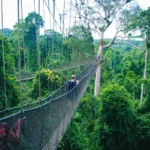
When this story starts, there is no country called Ghana and no European castle on this coast. There are forests, savannahs, rivers and shorelines—and people who know how to live within them. So before we meet the ships, we must first meet the world they entered.
02 · A lived-in world
Families were already building lives here.
Across the lands that would much later become Ghana, people farmed, fished, raised families, made tools and built settlements. Archaeology shows that the southern forest was well populated by farming communities long before Atlantic trade began. This was not empty territory waiting to be discovered.
03 · Knowledge and work
The landscape held skill as well as wealth.
Knowledge travelled through daily work: growing food, working iron, shaping clay, weaving, building and finding gold in streams and the earth. These skills supported households and rulers. They also produced goods that could move far beyond the place where they were made.
04 · Roads before the Atlantic
Trade already looked north.
Gold and kola from the forest moved toward markets in the savannah and into wider West African networks. Salt, cloth, copper and other goods moved in return. Towns such as Begho became important meeting places within these exchanges. The Atlantic did not create commerce here; it entered and redirected commerce that already existed.
05 · Power and negotiation
Outsiders would have to deal with African authorities.
Trade depended on rules, relationships and political authority. Bono Manso was taking shape as a centre of the Bono state by the early fifteenth century. Along the coast and inland, communities and rulers controlled access to land and exchange. When Europeans later sought trading posts, they could not simply place them wherever they pleased.
06 · The next question
Then sails appeared beyond the coast.
In 1471, Portuguese mariners reached this coast. They came looking for access to West African gold and a sea route into trade that had long moved overland. Their arrival did not begin Ghana’s history. It began a new struggle over how an existing world would connect to the Atlantic. Next: why did gold lead to a fort?
What to remember
This chapter uses the outline of modern Ghana only as a geographic guide. The country did not yet exist. Animated lines describe broad networks of exchange, not one fixed road or a single person’s journey.
Sources and further reading
- Chouin and DeCorse — Prelude to the Atlantic Trade — Pre-Atlantic settlement and agriculture in southern Ghana
- UNESCO — General History of Africa, Volume IV — Begho, forest–savannah trade, gold and kola
- The Metropolitan Museum of Art — Arts of Africa — Overland gold networks and Portuguese coastal contact
- Flight — Chronology of Bono-Manso — Early-fifteenth-century formation of Bono Manso
Continue with VibesGhana
This is a living historical record. If you identify an error or important omission, please contact VibesGhana with the chapter, place and source where possible.