I’ve stood at the Door of No Return when the tide was loud and nobody on the tour could find a word to say. I’ve also eaten waakye out of a leaf at 7am because that’s when the good pot runs out. Ghana rewards both kinds of traveller — the one chasing history and the one chasing breakfast — and the trick is knowing which experiences actually earn a place on a short trip.
This is a local’s shortlist, not a scrape of the same ten attractions everyone copies. For each one you’ll get the honest version: what it’s really like, when to go, and whether it’s worth the detour. If you’re travelling for the diaspora homecoming — the energy that started with the Year of Return and never really stopped — I’ve flagged the stops that hit hardest. First, the quick list, then the detail.
The short list: 15 best things to do in Ghana
- Stand at the Door of No Return — Cape Coast & Elmina castles
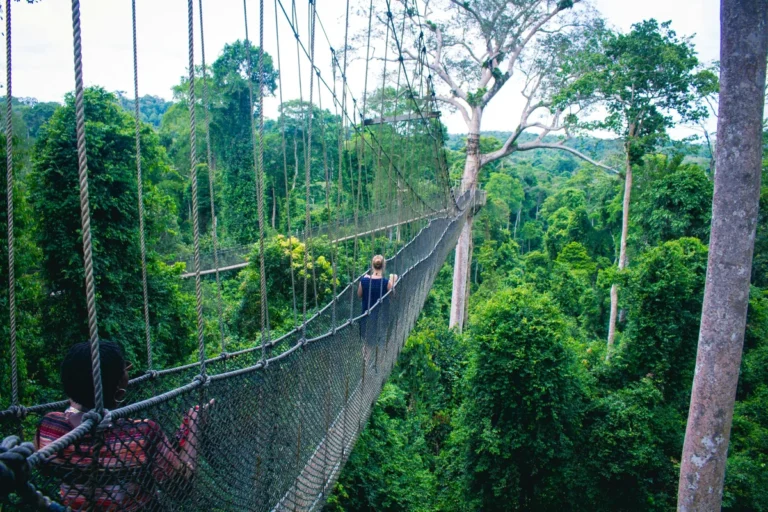
- Walk the treetops at Kakum National Park
- Track elephants on foot at Mole
- Feel the Asante heartland in Kumasi
- Give Accra a proper day and night
- Chase waterfalls in the Volta hills
- Find your beach — Kokrobite to Busua
- Time your trip with a festival
- Canoe into Nzulezo, the village on stilts
- Eat everything — chop bars to fine dining
- Breathe in the hills at Aburi Botanical Gardens
- Hold a crocodile at Paga
- Cruise Lake Volta to Dodi Island
- Get lost in Makola and Kejetia markets
- See the old mud mosque at Larabanga
1. Stand at the Door of No Return — Cape Coast & Elmina castles
If you do one thing in Ghana, make it this. The whitewashed castles at Cape Coast and Elmina are UNESCO World Heritage sites and the most important stops on any journey into the transatlantic slave trade. Elmina, built by the Portuguese in 1482, is the oldest surviving European building south of the Sahara. You walk through the dungeons, then through the Door of No Return — the last threshold enslaved Africans crossed before the ships. Go with a guide, don’t rush it, and budget emotional space for the rest of the day. The two castles are 30 minutes apart on the coast west of Accra; pair them with Kakum and you have a perfect two-day loop. See our best time to visit guide before you lock dates.
2. Walk the treetops at Kakum National Park
Kakum’s canopy walkway is the photo you’ve already seen of Ghana: seven rope-and-plank bridges strung 40 metres above the rainforest floor. It’s a genuine rush and over faster than you’d think, so go early — the first slot beats both the heat and the tour buses. The forest below shelters forest elephants, monkeys and over 250 bird species, though you’re more likely to hear them than see them on the walkway. Tip: it’s an easy add-on to Cape Coast (about 45 minutes inland), so don’t make a separate trip of it.
3. Track elephants on foot at Mole National Park
Mole is Ghana’s largest wildlife reserve, up in the savannah north, and its party trick is the walking safari — you set off on foot with an armed ranger and close in on elephants at the waterhole. There are antelope, warthogs, baboons and birds everywhere; the lodges on the escarpment look straight down onto the animals. It’s a long haul from the coast (fly to Tamale to save a day), but it’s the closest thing Ghana has to a classic safari, and far cheaper than East Africa. Combine it with Larabanga (below).
4. Feel the Asante heartland in Kumasi
Kumasi is the soul of the Asante kingdom and a different Ghana from the coast. Start at Manhyia Palace to understand the still-living monarchy, then dive into the craft villages on the edge of town: Bonwire and Adanwomase for kente weaving you can watch on the loom, and Ahwiaa for woodcarving. Kejetia, one of the largest markets in West Africa, is overwhelming in the best way. This is the place to buy cloth with real meaning rather than airport souvenirs.
5. Give Accra a proper day and night
Most visitors treat Accra as an airport with traffic. Don’t. Spend a day on Black Star Square and the Kwame Nkrumah Memorial, the artists’ shacks and boxing gyms of historic Jamestown, and the galleries and rooftops of Osu and Labone. Then give it a night — Accra’s live highlife, afrobeats and rooftop bar scene is genuinely world-class, especially in December when the diaspora floods home for Detty December. Hungry? Our food guide maps the chop bars and restaurants worth your appetite.
6. Chase waterfalls in the Volta hills
East of the Volta River the land folds into green hills, and this is Ghana’s best region for slow, active days. Wli Waterfalls is the tallest in West Africa — a flat hike to the lower falls, a sweaty climb to the upper. Nearby you can summit Mount Afadja (Afadjato), Ghana’s highest peak, before breakfast, or let the sacred Mona monkeys climb onto your arm at Tafi Atome. It’s underrated precisely because it’s a detour — which is exactly why it’s worth one.
7. Find your beach — Kokrobite to Busua
Ghana’s coast runs the full range. Near Accra, Kokrobite (home of Big Milly’s) is the backpacker drum-and-reggae classic, while Bojo and Labadi are easy day trips. Head west and the beaches get dreamier: Busua is the surf town to slow down in, and Cape Three Points and Axim feel genuinely off-grid. For the full rundown of where to swim, surf and stay, read our dedicated Ghana beaches guide.
8. Time your trip with a festival
Ghanaian festivals are the single best way to see the culture switched fully on. Homowo (Ga, Aug–Sep) sprinkles kpokpoi through the streets of Accra; Chale Wote turns Jamestown into a wild street-art party each August; Aboakyer in Winneba is a live deer hunt; Hogbetsotso gathers the Anlo-Ewe in November. Plan around one and your whole trip levels up — see the full calendar in our Ghana festivals guide.
9. Canoe into Nzulezo, the village on stilts
In the far southwest, an hour’s paddle through reeds and lagoon brings you to Nzulezo — an entire village built on stilts over Lake Tadane, lived in for generations. It’s calm, strange and beautiful, and the canoe ride is half the experience. Pair it with the Ankasa rainforest or the western beaches; you’re already a long way from Accra, so make the corner count.
10. Eat everything — chop bars to fine dining
Ghanaian food is the trip’s quiet headline. Eat jollof (and join the eternal argument over whose is best), waakye from a leaf at breakfast, banku with grilled tilapia and fiery pepper, fufu in light soup, and red-red with fried plantain. Street food is where the soul is; Accra also has a serious modern dining scene now. Come hungry and ask locals where they actually eat — the answer is rarely the place with the big sign.
11. Breathe in the hills at Aburi Botanical Gardens
Forty-five minutes up the Akuapem ridge from Accra, Aburi is where the city goes to cool down. The colonial-era botanical gardens are shady and walkable, the air is noticeably fresher, and the roadside is lined with woodcarvers. It’s the easiest half-day escape from the capital, and a good antidote if Accra’s heat and traffic start to wear on you.
12. Hold a crocodile at Paga
Up at the Burkina Faso border, the crocodiles of Paga are considered sacred and, remarkably, harmless to people — guides coax them out of the pond with a guinea fowl and yes, you can sit beside one for the photo. It’s touristy and unforgettable at the same time. Only worth it if you’re already exploring the Upper East (pair it with the painted houses of Sirigu), but if you are, it’s a story you’ll dine out on for years.
13. Cruise Lake Volta to Dodi Island
Lake Volta is one of the largest man-made lakes on earth. From Akosombo you can take a relaxed cruise out to Dodi Island — highlife band, dancing, and a slow afternoon on the water that locals love for a reason. It’s the lazy counterpoint to all the hiking and history, and an easy add-on to a Volta or Eastern Region trip.
14. Get lost in Makola and Kejetia markets
To feel a Ghanaian city’s pulse, skip the mall and walk a market. Makola in Accra and Kejetia in Kumasi are vast, loud, dense with cloth, beads, spices and everything else — chaotic, friendly, and the best people-watching in the country. Go with small notes, keep your phone tucked away, and let a trader walk you through the fabrics. It’s shopping as a full-contact sport.
15. See the old mud mosque at Larabanga
On the doorstep of Mole, Larabanga’s mosque is one of the oldest in West Africa — a striking Sudanese-style structure of mud and timber that looks unchanged for centuries. It’s small and the visit is quick, but combined with the nearby “Mystic Stone,” it’s the perfect cultural bookend to a Mole safari and a reminder that the north has a deep, distinct heritage of its own.
How to actually fit it together
You can’t do all fifteen in a week, so build around three anchors:
- The coast & history loop (3–4 days): Accra → Cape Coast & Elmina → Kakum → western beaches. The classic first-timer route.
- The northern adventure (3–4 days): fly Accra–Tamale → Mole walking safari → Larabanga → (push on to Paga if you have time).
- The green detour (2–3 days): Aburi → Akosombo & Lake Volta → Wli Falls and the Volta hills.
Most one-week trips do the coast loop plus Accra; two weeks lets you add the north or the Volta. For full day-by-day routes, see our Ghana itinerary guide, sort your visa early, and check our best time to visit before you book flights.