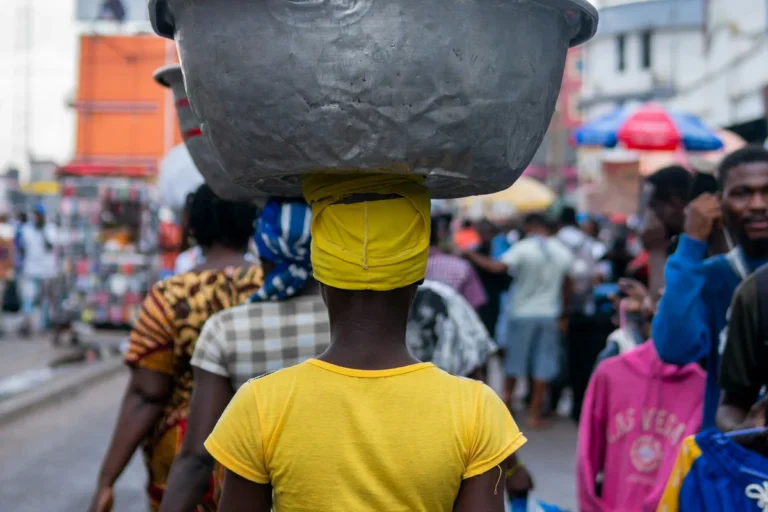
Step off the plane at Kotoka and the first word you’ll meet is Akwaaba — “welcome” in Twi. Ride into town and you’ll hear the driver switch between English, Twi and Pidgin in a single sentence. Ghana is one of the most gloriously multilingual places on earth: a country of around 80 languages where nearly everyone speaks two or three, and switching between them mid-conversation is just… normal. Here’s who speaks what, where, and a few words that will make people light up when you try them.
English: the common ground
Ghana’s official language is English, a legacy of British colonial rule. It’s the language of government, the courts, business, signage and most schooling from upper primary onward — and it’s the neutral glue that lets a Ga trader, an Ewe teacher and a Dagomba student all do business. Crucially, English was kept as the official language precisely because it belongs to no single ethnic group; choosing any one Ghanaian language would have felt like favouritism. For visitors, this is the headline: you can travel Ghana comfortably in English. But learn even a word or two of the local languages and doors — and hearts — swing wide open.
Akan: the giant
If Ghana has an unofficial national language, it’s Akan. Around 44% of Ghanaians speak it as a mother tongue, and roughly 80% speak it as a first or second language — making it the country’s de-facto lingua franca across the south and centre. Akan isn’t one single thing, though; it’s a cluster of closely related dialects:
- Twi — the big one, split into Asante Twi (Kumasi and the Ashanti Region) and Akuapem Twi (Eastern Region). This is the Twi you’ll hear most.
- Fante — spoken along the central coast around Cape Coast and Elmina.
- Plus related tongues like Bono, Akyem and Kwahu.
Akan gave the world plenty of words you already know — and the day names Ghanaians are often named after (Kwame, Ama, Kofi, Akosua). Want a head start? Our guide to essential Twi phrases and the story of Akwaaba are the perfect place to begin.
The other big southern languages
The south and coast are the heartland of the Kwa languages. Beyond Akan, three stand out:
- Ewe — the language of the Volta Region in the southeast, with around 3.8 million speakers. Musical and expressive, it’s written with some wonderful extra letters (Ð, ƒ, ϒ).
- Ga — the indigenous language of Accra and the coast around the capital. If you’re in the city, Ga is the sound of home turf, alongside its close cousin Dangme.
- Nzema — spoken in the far southwest near the Ivorian border (and the mother tongue of Ghana’s first president, Kwame Nkrumah).
The languages of the north
Head north and the soundscape changes entirely: these are mostly Gur (Mole-Dagbani) languages, a different branch of the family.
- Dagbani — the language of Dagbon and the north’s biggest city, Tamale; your gateway tongue for a Mole safari.
- Dagaare and Frafra (Farefare) — widely spoken across the Upper West and Upper East.
- Gonja — a Kwa language spread across the vast Savannah Region.
- Kasem — near the northern border around Paga and its famous crocodile pond.
Hausa and the Zongo
There’s one more lingua franca you’ll hear in every city: Hausa. In the zongo — the historically Muslim, trader neighbourhoods found in towns across Ghana — Hausa is the shared tongue that lets people of many different ethnic backgrounds do business and worship together. The local flavour has even earned its own nickname: “Gaananci”, or Ghanaian Hausa. It’s a beautiful example of how a language can become a bridge rather than a border.
Ghanaian Pidgin English: the street tongue
Then there’s the language of the streets, the campus and the group chat: Ghanaian Pidgin English. With an estimated 5 million speakers, this English-based creole is the relaxed, playful register young Ghanaians (and plenty of older ones) slip into among friends. It’s expressive, funny, and everywhere — and catching a few phrases will instantly make you feel less like a tourist. “Chale” (mate/friend) is your gateway word.
What makes Ghana’s languages tick
A few things unite this diversity. Almost all of Ghana’s indigenous languages belong to the huge Niger-Congo family, splitting mainly into Kwa (the south: Akan, Ga-Dangme, Ewe, Nzema, Gonja) and Gur (the north: Dagbani, Dagaare, Kasem, Frafra). Many are tonal — the pitch of a syllable can change a word’s meaning entirely — and their alphabets include special letters you won’t find in English, like ɛ, ɔ and ŋ. To keep it all organised, the Bureau of Ghana Languages (founded in 1951) officially supports eleven of them: the three Akan dialects (Asante Twi, Akuapem Twi and Fante) plus Ewe, Ga, Dangme, Dagbani, Dagaare, Nzema, Gonja and Kasem.
| Language | Where / who | “Welcome / hello” | “Thank you” |
|---|---|---|---|
| Akan (Twi) | Ashanti, Eastern, Bono — and everywhere | Akwaaba | Medaase |
| Fante | Central coast (Cape Coast) | Akwaaba | Medaase |
| Ewe | Volta Region (southeast) | Woézɔ | Akpe |
| Ga | Greater Accra | Ojekoo | Oyiwaladɔŋŋ |
| Dagbani | Dagbon / Northern (Tamale) | Dasiba (good morning) | M paɣiya |
| Hausa | Zongo communities, nationwide | Sannu | Na gode |
Pronunciations are approximate — and Ghanaians will love you for trying anyway.
A few words to win hearts
You don’t need to be fluent. A single word, offered with a smile, is worth a hundred perfectly-formed sentences. Start with these Twi essentials (the most widely understood):
- Akwaaba — welcome
- Ɛte sɛn? (eh-teh-sen) — how are you?
- Me ho yɛ — I’m fine
- Medaase (meh-daa-si) — thank you
- Aane / Daabi — yes / no
- Chale — mate (Pidgin, works everywhere)
Greetings matter enormously in Ghana — you always greet before you ask (more in our etiquette guide). And the culture behind the words is a whole world of its own; dip into Ghanaian culture and the dances that carry these languages in motion.
Will English get me by?
Yes — comfortably. Signs, menus, hotels, tours, transport apps and most people you’ll deal with operate in English, especially in Accra, Kumasi and the tourist trail. The local languages are the bonus round: learn a greeting for wherever you’re headed (Twi for Ashanti, Ga for Accra, Ewe for the Volta, Dagbani for the north) and watch how quickly a transaction becomes a conversation, and a conversation becomes an invitation.
The bottom line
Ghana’s roughly 80 languages aren’t a barrier — they’re one of the best things about it. English gets you everywhere; Akan gets you most places; and a handful of local words gets you something money can’t buy: a warm, delighted Akwaaba. So learn your medaase, throw in a chale, and let Ghana talk back.
Sources & further reading
- Wikipedia — Languages of Ghana
- Wikipedia — Akan language
- Statista — Ghana: languages by number of speakers
- Ghana Journal of Linguistics — Hausa in Ghana (“Gaananci”)