Ghana is a nation of many peoples. Packed into a country roughly the size of the United Kingdom are more than 70 ethnic groups, each with its own language, kingdom, dress, cuisine and customs — yet bound together by a national identity so strong that Ghana is often held up as one of Africa’s great success stories in unity. From the gold-draped courts of the Asante to the smock-clad chiefs of the north, here’s a traveller’s guide to the tribes — more properly, the ethnic groups — of Ghana.
“Tribe” or “ethnic group”?
A quick note on words. “Tribe” is the term many travellers search for and many Ghanaians use casually, but scholars and increasingly Ghanaians themselves prefer ethnic group, which better reflects these are large, sophisticated societies — some historically vast kingdoms — not small isolated bands. We’ll use the terms interchangeably here, with respect for all of them.
The big picture
According to Ghana’s 2021 Population and Housing Census, the population breaks down into a handful of major ethnic clusters. The three largest — Akan, Mole-Dagbani and Ewe — together make up more than three-quarters of all Ghanaians.
| Ethnic group | Share (2021) | Heartland |
|---|---|---|
| Akan | 45.7% | Ashanti, Eastern, Central, Western, Bono |
| Mole-Dagbani | 18.5% | Northern, North East, Savannah, Upper regions |
| Ewe | 12.8% | Volta Region (southeast) |
| Ga-Dangme | 7.1% | Greater Accra & southeast coast |
| Gurma | ~6.4% | Upper East, northeast |
| Guan | ~3.2% | Scattered — among Ghana’s oldest inhabitants |
| Grusi | ~2.7% | Upper East & West |
| Mande | ~2.0% | North & Zongo communities |
The Akan: gold, kente and the Golden Stool
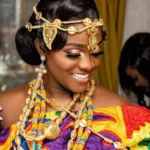
The Akan are Ghana’s largest group by far, dominant across the south and centre, and their culture is what much of the world pictures as “Ghanaian”: kente cloth, gold regalia, talking drums, and the powerful Asante kingdom centred on Kumasi, whose sacred Golden Stool is said to house the soul of the nation. The Akan are famously matrilineal — inheritance and clan identity pass through the mother’s line. Major Akan subgroups include:
- Asante (Ashanti) — the gold-rich kingdom of Kumasi.
- Fante — the central coast around Cape Coast and Elmina.
- Akyem, Akuapem, Kwahu, Bono (Brong) — the eastern and central hills and forests.
- Nzema — the far southwest (home of Ghana’s first president, Kwame Nkrumah).
The north: Mole-Dagbani and the kingdoms of the savannah
Ghana’s second-largest cluster, the Mole-Dagbani, anchors the northern savannah. These are proud, historically centralised societies with powerful chieftaincies. The Dagomba of the Dagbon kingdom (around Tamale) are the best known, alongside the Mamprusi, Nanumba and the neighbouring Gonja. Northern culture has its own distinct signature — the woven fugu/batakari smock worn by chiefs and celebrated at festivals like Damba, a strong Islamic influence, and the haunting music of the one-string gonje fiddle and talking drums.
The Ewe: weavers of the southeast
East of the Volta River live the Ewe, a group spread across southeastern Ghana (and into Togo and Benin). The Ewe are celebrated weavers — their Kete cloth rivals Asante kente — and master drummers, whose Agbadza rhythms are among West Africa’s most electrifying. Their annual Hogbetsotso festival commemorates a dramatic ancestral escape from a walled tyrant’s city, and they are known for close-knit communities and a rich spiritual tradition.
The Ga-Dangme: the people of Accra
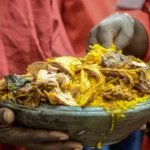
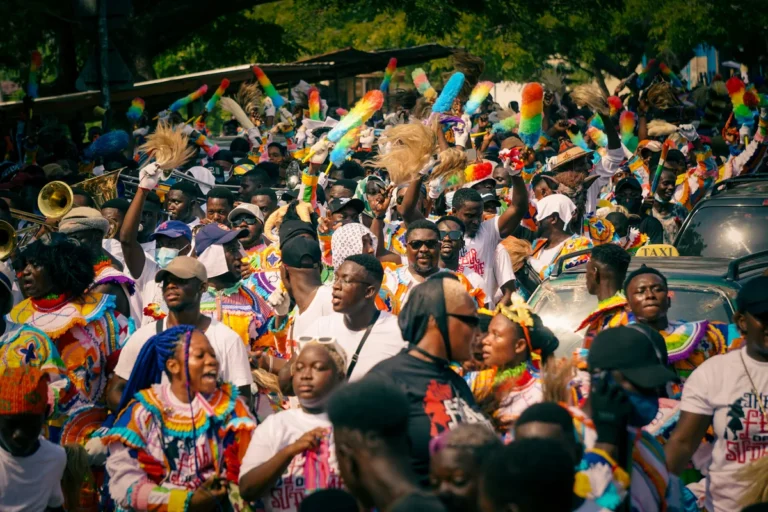
The Ga and closely related Dangme are the indigenous people of the capital and the southeastern coast. Historically fishermen and traders, the Ga gave Accra its neighbourhoods, its language and its most joyful festival: Homowo, which “hoots at hunger” with a feast of kpokpoi and a raucous street procession. Ga culture — from Jamestown’s boxing gyms to the famous fantasy coffins — is woven right through the life of the city.
The first arrivals and the smaller groups
Beyond the big four, Ghana’s tapestry includes the Guan, believed to be among the oldest inhabitants of Ghana, who settled long before later migrations and are now scattered from the coast to the north; the Gurma of the northeast; and the Grusi (including the Frafra and Kasena) of the Upper regions. In every city you’ll also find Zongo communities — historically Muslim, Hausa-speaking trading quarters that blend peoples from across West Africa.
Many peoples, one Ghana
What makes Ghana remarkable is not just its diversity but its cohesion. No single group dominates the state, chieftaincy remains a respected living institution, and intermarriage and internal migration have knitted the groups together. Ghanaians tend to hold their ethnic identity and their national identity comfortably at once — proudly Asante or Ewe or Ga and proudly Ghanaian. For a traveller, that means wherever you go, you’ll meet a distinct culture and the same warm Ghanaian hospitality.