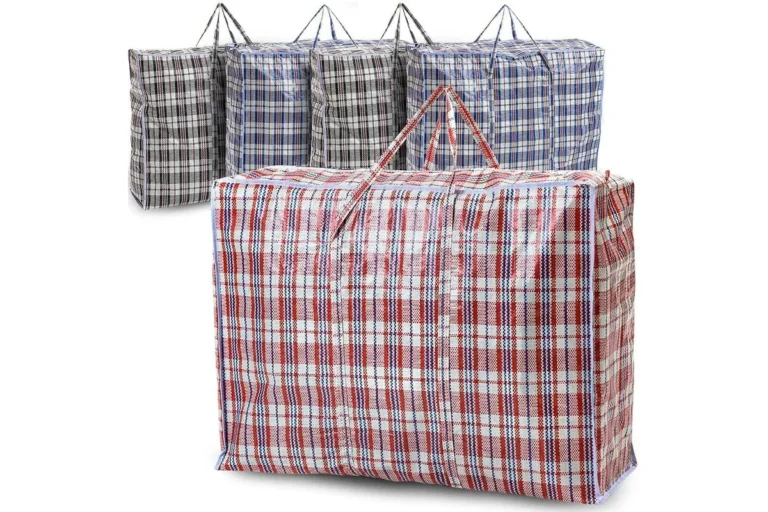
You have almost certainly seen it, even if you never knew its name: the big, glossy, red-white-and-blue (or green, or black) checkered woven plastic bag with the zip across the top and the sturdy handles. It carries laundry across cities, market goods across borders, and entire households across continents. In Ghana and Nigeria it has a name loaded with history — the Ghana Must Go bag — and behind that cheap, cheerful plaid lies one of West Africa’s most turbulent modern stories.
What exactly is a “Ghana Must Go” bag?
Physically, it’s humble: a large tote woven from polypropylene plastic in a bold tartan check, finished with a zip and reinforced handles. It is astonishingly cheap, nearly indestructible, waterproof-ish, and enormous — capable of swallowing a family’s worth of clothes or a trader’s entire stock. Those same virtues are why it turns up everywhere from Accra’s markets to laundromats in London and moving days in New York. But the name it carries in West Africa comes from something far heavier than laundry.
The painful history behind the name
To understand the name, rewind to the late 1970s and early 1980s. Ghana was in the grip of a brutal economic collapse — drought, food shortages and political turmoil — while neighbouring Nigeria was booming on oil money. Millions of Ghanaians, among other West Africans, migrated east in search of work, filling jobs as teachers, artisans, traders and labourers.
Then the tide turned. As Nigeria’s own economy soured and political pressure mounted, the government of President Shehu Shagari issued an executive order in January 1983 giving undocumented immigrants just weeks to leave. Up to two million people — a great many of them Ghanaians — were forced out almost overnight in one of modern Africa’s largest expulsions. Fleeing with whatever they could carry, they stuffed their belongings into those cheap checkered plastic bags. Nigerians nicknamed the exodus — and the bags — “Ghana Must Go.” The name stuck to the luggage forever.
An uncomfortable irony
History here cuts both ways, and it’s worth telling honestly. Just over a decade earlier, in 1969, Ghana itself had done something similar: the government’s Aliens Compliance Order expelled large numbers of foreign nationals — many of them Nigerians — from Ghana. The 1983 expulsion was, in part, a bitter echo of that. Two neighbours, two waves of expulsion, and one humble bag left carrying the memory of both.
One bag, a hundred names
Here is the fascinating part: the very same bag exists all over the world, and almost everywhere it is named after somebody’s displaced people. It is the migrant’s suitcase, wherever migration has happened:
| Where | What they call it |
|---|---|
| Ghana & Nigeria | “Ghana Must Go” |
| Germany | “Türkenkoffer” (Turkish suitcase) |
| United States | “Chinatown tote” |
| Guyana | “Guyanese Samsonite” |
| UK / South Asia | “Bangladeshi bag” |
| Around the world | “Refugee bag” |
From symbol of exile to fashion icon
In a twist few could have predicted, the bag has been reclaimed — and even glamorised. In 2007, the fashion house Louis Vuitton sent a checkered tote unmistakably inspired by the Ghana Must Go bag down its runway, reportedly priced at close to $2,000; later, houses like Balenciaga played with the same instantly recognisable plaid. Artists and writers across the African diaspora have seized on it too — most famously the acclaimed novel Ghana Must Go by Taiye Selasi — turning a symbol of hardship into one of resilience, memory and identity. What was once an emblem of being unwanted has become, for many, a badge of survival.
The bag today
Strip away the history and, in Ghana, the bag is simply everywhere — and indispensable. Students haul their belongings home in it each term. Traders move stock in it. Families store dry-season clothes in it. It’s the default for anyone moving house, travelling by tro-tro with too much luggage, or sending goods to relatives abroad. Cheap, vast and tough as nails, it has quietly become one of the most recognisable objects in Ghanaian everyday life — a piece of design so ordinary that most people never stop to think about the extraordinary story folded inside it.
The bottom line
The Ghana Must Go bag is proof that the humblest objects can carry the heaviest histories. Born of hardship and named in unkindness, it has been carried, reclaimed and reinvented — a little woven monument to migration, endurance and the West African talent for turning pain into something you can laugh with, and live with. Next time you spot that red-and-blue check, you’ll know exactly what it’s carrying. For more on the culture that produced it, explore the peoples of Ghana and the warmth that endures through it all.