Kente is Ghana’s most famous cloth — the radiant, handwoven fabric of Asante kings, now worn worldwide as a symbol of African heritage. But if you want the real thing, where you buy matters enormously. There’s a world of difference between a machine-printed “kente print” from a market stall and a genuine hand-woven cloth from a master weaver in an Ashanti village. Here’s where to buy kente in Ghana, how to spot the authentic article, and what to pay.
Where to buy kente
| Place | Best for |
|---|---|
| Bonwire (Ashanti) | The legendary kente-weaving village |
| Adanwomase (Ashanti) | Weaving tours & buying direct |
| Accra Arts Centre | Convenient variety (bargain hard) |
| Kumasi Cultural Centre | Quality cloth in the city |
| Kpetoe (Volta) | Ewe kente, a distinct tradition |
Go to the source: the weaving villages
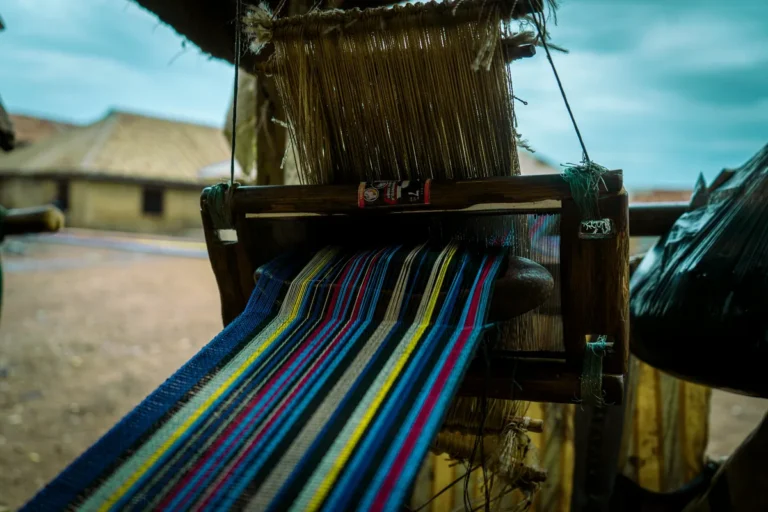
For the best kente — and the best experience — head to the Ashanti weaving villages near Kumasi. Bonwire is the most famous, the legendary birthplace of Asante kente, and Adanwomase offers excellent visitor tours where you watch weavers work the narrow looms and buy directly from them. Buying here means better prices, guaranteed authenticity, and your money going straight to the artisan. The Volta town of Kpetoe is the home of the distinct Ewe kente tradition. See our full kente cloth guide.
Woven vs printed
The key distinction: hand-woven kente is made from narrow strips (about 10cm wide) woven on a loom and sewn together, so it has slight irregularities, visible seams between strips, and weight — and it’s expensive. “Kente print” is the kente pattern machine-printed onto smooth, uniform cotton; it’s cheap, light, and fine for casual wear or gifts, but it isn’t true kente. Both have their place — just know which you’re paying for.
What to pay
Printed kente cloth runs roughly GH₵120–300 for six yards; a genuine hand-woven stole or strip starts around GH₵250 and climbs well past GH₵800 for large, finely woven pieces in silk or complex patterns. Prices rise with strip count, thread quality and pattern intricacy. At the Arts Centre, expect inflated opening quotes and bargain; at the villages, prices are fairer to start. See our souvenir price guide.
Tips for buying kente
- Buy in the villages (Bonwire, Adanwomase) for authenticity and value.
- Check the weave — real kente has sewn strips and small irregularities.
- Ask the pattern’s meaning; named designs carry proverbs and status.
- Bargain at the Arts Centre, less so at source.
- Carry cash/MoMo and leave luggage space.
The bottom line
To buy kente well, go to the Ashanti weaving villages — Bonwire and Adanwomase — where you can watch it made and buy the genuine hand-woven article direct. Use the Arts Centre for convenience (and haggle), know woven from printed, and ask what the pattern means. You’ll come home with cloth that carries real history. Learn the story in our kente guide and plan more via shopping in Ghana.