Travel north in Ghana and the soundtrack changes from gospel to the call to prayer. Islam has been part of Ghana for centuries, carried south along trans-Saharan trade routes, and today it shapes the culture of the north — in the daily rhythm of prayer, the Sahelian architecture, and some of the country’s most extraordinary buildings: ancient mud-and-stick mosques that look unchanged in 600 years. Here’s a guide to Islam and mosques in Ghana, the ones worth visiting, and how to do so respectfully.
Islam in Ghana
Muslims make up a significant share of Ghana’s population, concentrated in the north (the Northern, Savannah, Upper East and Upper West regions) and in the zongo communities of southern cities like Accra and Kumasi. Islam arrived via trans-Saharan trade from around the 15th century, and northern culture — the Dagomba, Gonja, Mamprusi and others — is deeply shaped by it, from festivals like Damba and the Bugum (Fire) Festival to the smock-wearing chiefs and the architecture. Ghana’s religious tolerance means mosque and church often stand side by side.
The ancient mud mosques
Ghana’s most remarkable Islamic sites are its ancient Sudanese-style mosques — built from mud and timber with distinctive protruding wooden stakes and conical towers, a style stretching across the Sahel.
| Mosque | Where | Note |
|---|---|---|
| Larabanga Mosque | Savannah (near Mole) | The most famous; one of West Africa’s oldest |
| Nakore Mosque | Upper West (near Wa) | A beautiful, lesser-known example |
| Banda Nkwanta / Maluwe | Savannah | Classic Sudanese mud architecture |
| Bole & Wuriyanga | Savannah / North East | More historic mud mosques |
Larabanga and the Sudanese style
The star is the Larabanga Mosque, on the doorstep of Mole National Park — a small, striking white-and-mud structure often called one of the oldest mosques in West Africa, paired with the legendary “Mystic Stone.” It’s the highlight of any northern trip (see our Savannah Region guide). Several similar mud mosques dot the Savannah and Upper West, each a living piece of Sahelian heritage.
The great city mosques
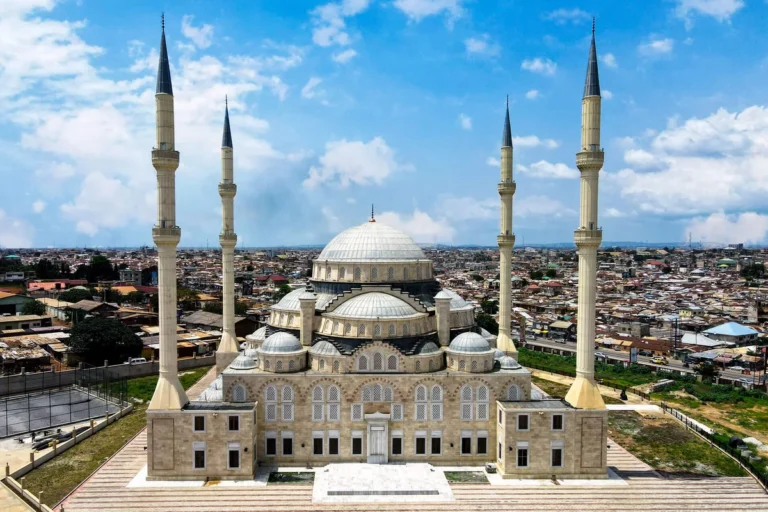
Ghana’s cities have grand modern mosques too. The vast Ghana National Mosque in Accra (a striking Turkish-built complex) is among the largest in West Africa, and Tamale’s Central Mosque anchors the northern capital. These are active places of worship and impressive landmarks, busiest and most atmospheric at Friday prayers.
Visiting respectfully
- Dress modestly — cover shoulders, arms and legs; women may be asked to cover their hair.
- Remove your shoes before entering, and ask permission first.
- At the mud mosques, non-Muslims usually view and photograph from outside — pay the small guide fee and respect any restrictions.
- Avoid prayer times for visits unless invited, and be discreet during Friday prayers.
- Ask before photographing people (see our etiquette guide).
The bottom line
Islam gives northern Ghana much of its distinct character, and its ancient mud mosques — led by Larabanga near Mole — are among the most evocative sights in the country. Pair a mosque visit with a northern safari, dress modestly, take a guide, and you’ll add real depth to your trip. Explore more of the country’s faith and culture in our Ghanaian culture guide.