You’ve seen it even if you’ve never been to Ghana — the dazzling, geometric, jewel-bright cloth draped over graduates’ gowns and worn by kings: kente. But kente is far more than a beautiful fabric. Every colour carries meaning, every pattern has a name and a proverb, and each strip is still woven by hand on narrow looms exactly as it was centuries ago. To the Asante and Ewe who created it, kente is woven history — a language you wear. Here’s the story behind Ghana’s most iconic textile: where it came from, how it’s made, what the colours mean, and where to buy the real thing. To understand the history, colors, and symbolism of the cloth before your trip, visit KenteCloth.com and check out the article on Kente Cloth Designs and Patterns
What is kente cloth?
Kente is a handwoven cloth made of interlaced silk and cotton strips, native to the Asante (Ashanti) of Ghana and the Ewe of the Volta region. Each piece is built from long, narrow woven bands (about 10cm wide) that are sewn edge-to-edge into a larger cloth. Traditionally it was royal cloth — reserved for the Asante king and chiefs on the grandest occasions — and it remains the most prestigious fabric in Ghana, worn for the moments that matter most. The name is often traced to the word kenten, meaning “basket,” for its woven, basket-like pattern.
The origin story
Legend gives kente a wonderfully Ghanaian beginning: two weavers from Bonwire, near Kumasi, are said to have watched Kweku Ananse the spider spinning his web and been inspired to recreate its intricate patterns in thread — first in raffia, later in silk unravelled from imported cloth. By the 17th–18th century, kente weaving was flourishing under the Asante kingdom, with the finest cloths commissioned by royalty and each new pattern requiring the king’s approval. The Ewe developed their own rich tradition in parallel, often with more pictorial, representational motifs. Today Bonwire and nearby Adanwomase remain the spiritual home of Asante kente.
How kente is woven
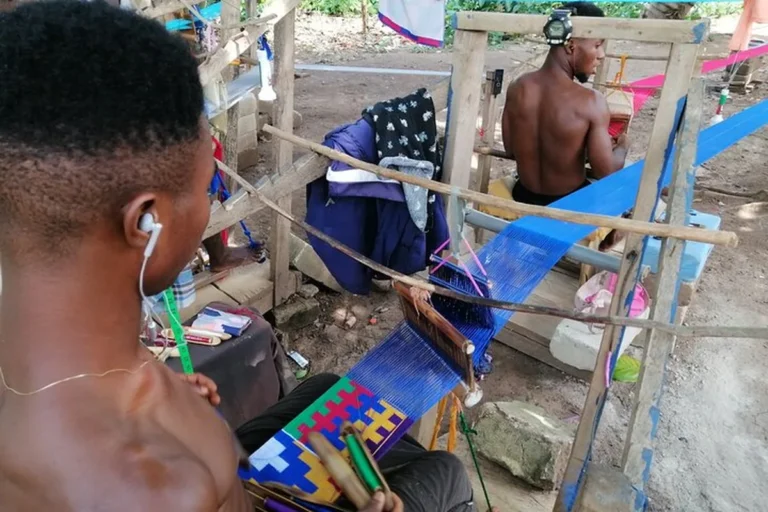
Real kente is made on a narrow strip loom, and watching it is mesmerising. The weaver sits at the loom with the warp threads stretching far out in front, working the foot pedals and shuttle to interlace warp and weft into a dense, patterned band. A single strip can take a day; a full cloth, weeks or months of strips woven, cut and hand-sewn together. The complexity, the silk, and the labour are why genuine kente is expensive — and why machine-printed “kente print” (cheap cotton with a kente design) is a different thing entirely. Both have their place; just know which you’re buying.
What the colours mean
Kente’s colours aren’t decorative — they’re symbolic. Here’s the traditional vocabulary:
| Colour | Meaning |
|---|---|
| Gold / yellow | Royalty, wealth, high status, glory |
| Black | Maturity, spiritual energy, ancestral connection |
| Green | Growth, renewal, fertility, harvest |
| Blue | Peace, harmony, love |
| Red | Political passion, sacrifice, struggle |
| White | Purity, festivity, the spiritual realm |
| Maroon / purple | Healing, the feminine, the earth |
Patterns with names and proverbs
Beyond colour, every kente pattern has a name — and often a proverb or piece of history attached. Famous designs include Adweneasa (“my skill is exhausted,” the weaver’s masterpiece), Oyokoman (linked to the Oyoko royal clan), Sika Futuro (“gold dust,” wealth) and Emaa Da (“it has not happened before,” novelty and creativity). Choosing a cloth, then, is choosing a message — which is why kente is given and worn so deliberately.
When kente is worn
Kente marks importance. You’ll see it at festivals and durbars (chiefs in full regalia), weddings and naming ceremonies, church on special Sundays, and — famously — draped as a stole over graduation gowns worldwide, a tradition embraced across the African diaspora. Wearing kente is a statement of pride, occasion and identity; it’s never just an outfit.
Kente vs adinkra
People often confuse Ghana’s two great cloth traditions. Kente is woven — colour and pattern built into the fabric on the loom. Adinkra is stamped — symbolic motifs printed onto plain cloth with carved calabash stamps and dye. Both carry meaning, both are Asante treasures, and together they form the visual language of the culture. Learn the symbol system in our adinkra symbols guide.
Where to buy real kente
For the authentic article, go to the source: Bonwire and Adanwomase near Kumasi, where you can watch weavers at the loom and buy directly — better prices and genuine, hand-woven cloth (see our Kumasi guide). In Accra, the Arts Centre and markets sell kente alongside everything else, but quality and authenticity vary, so look closely and haggle. A few buying tips: hand-woven kente has visible woven strips and slight irregularities; printed “kente” is smooth, uniform and far cheaper. Decide which you want, and pay accordingly — our shopping guide helps you bargain well.
The bottom line
Kente is Ghana woven into thread — royal cloth born in Bonwire, coloured with meaning, patterned with proverbs, and still made by hand strip by strip. Understand the colours and you can read a cloth; buy from the weavers in Bonwire or Adanwomase and you’ll bring home the real thing with a story attached. Whether you wear it to a wedding or hang it on a wall, kente carries a piece of the Asante soul. Pair this with our adinkra symbols and Ghanaian culture guides.